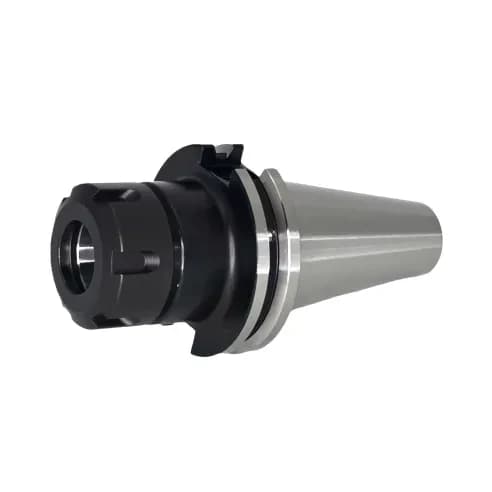
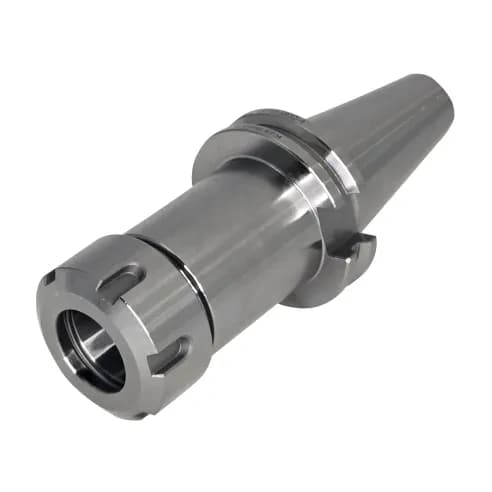
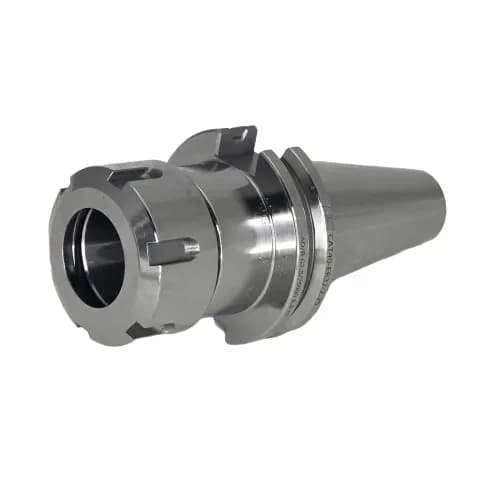
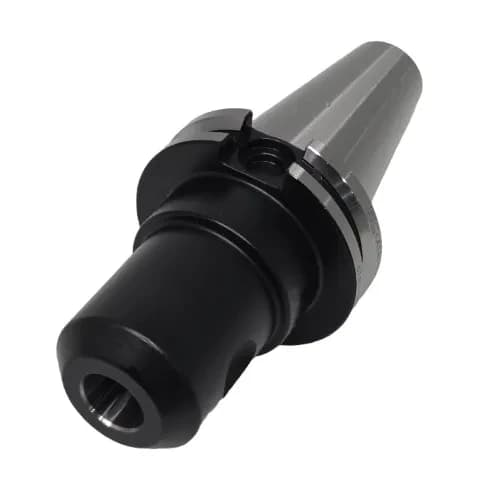
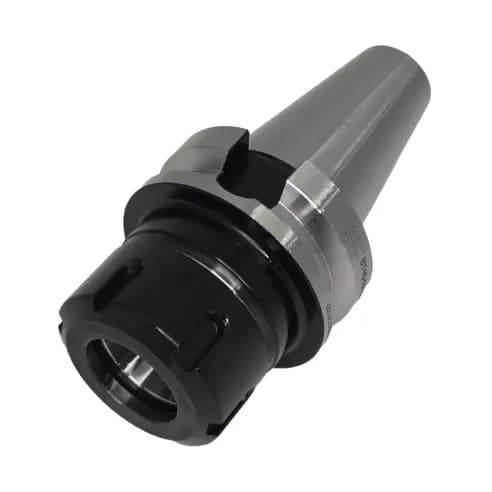
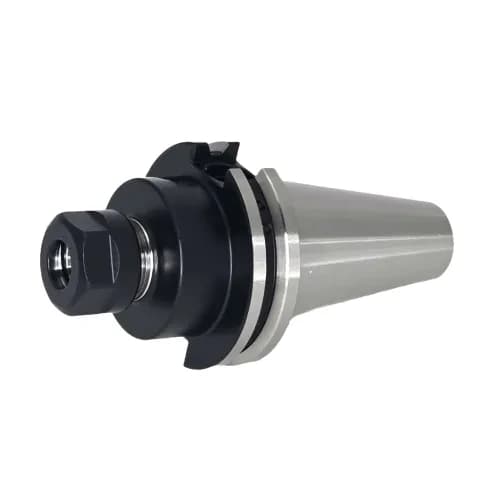
Milling tool holders, stocked in Canada. CAT40, BT40, SK40 and NBT30 tapers in ER collet chucks, Weldon end mill holders, shell and face mill arbors and power milling chucks — prices and stock on every product page, order without asking for a quote.
Two numbers decide which holder you want. Gage length sets how far the assembly stands out of the spindle, and deflection grows with the cube of that distance — so the shortest holder that reaches is the cheapest rigidity you can buy. Runout decides whether all the flutes on your cutter share the work or one of them does most of it and fails first.
Retention knobs are ordered separately and have to match the machine, not just the taper.
The holder is the part between your spindle and your cutter, and it decides more about the cut than most people expect. Runout, rigidity, how deep you can reach and whether the tool stays where you put it are all properties of the holder, not the end mill. A good cutter in a poor holder behaves like a poor cutter.
The range below covers CAT40, BT40, SK40 and NBT30 tapers in ER collet chucks, Weldon end mill holders, shell and face mill arbors and power milling chucks. Clamping range, gage length and balancing grade are on each product page.
Runout is paid for by the cutting tool
If the cutter does not run true, its flutes do not share the work. One edge takes a thicker chip than the others, wears faster, and the tool fails when that edge fails - not when the average edge is worn out. Runout does not shorten tool life a little; it shortens it in proportion to how unevenly the load is spread.
The runout you measure at the cutting edge is a stack: the spindle taper, the holder taper, the bore or collet that grips the shank, and the shank itself. Each part contributes, and they can add up or partly cancel depending on how the holder happens to seat. That is why the number worth knowing is the one measured at the tool, in your spindle - not the tolerance printed for the holder on its own.
Two practical consequences. Keep the taper and the spindle bore clean, because a chip trapped in the taper is worth more runout than any tolerance difference between holders. And indicate a new holder once with a test bar or a ground shank so you know what you actually have.
Gage length: the cheapest rigidity you can buy
Gage length is the distance from the spindle face to the nose of the holder, and it is in the name of every holder we sell for a reason. It sets how far the whole assembly stands out of the spindle, and deflection grows with the cube of that distance.
The practical rule is short: use the shortest holder that reaches the feature. Doubling the reach does not double deflection, it multiplies it by eight. A long holder chosen for convenience, when a short one would have cleared the fixture, is one of the most common reasons a cut chatters at parameters that ought to work.
Where a deep pocket genuinely needs the length, a slim-nose holder - a shrink-fit or a slender hydraulic chuck - gets in without the bulk of a collet nut, which is often what forced the long holder in the first place.
Clamping styles and what each is for
Every clamping style is a trade between grip, runout, flexibility and price. There is no best one.
ER collet chuck. The general-purpose holder. One chuck covers a whole range of shank diameters by swapping collets, which is why most shops own more of these than anything else. Runout and grip are moderate and depend heavily on collet condition. This is the default unless something specific pushes you off it.
Weldon / side-lock end mill holder. A screw clamps against a flat on the tool shank. That is a positive mechanical lock - the tool physically cannot pull out - so this is the choice for heavy roughing where axial pull is the failure mode. The cost is runout: the screw pushes the shank off centre by design. Roughing tool, not a finishing one.
Shell and face mill arbor. For arbor-mounted cutters rather than shank tools, driven by keys with a retaining screw through the middle.
Power milling chuck. Needle-roller mechanism giving high clamping torque with better runout than a Weldon holder. Where you want to rough hard without giving up accuracy.
Hydraulic chuck. Clamps by pressurising a thin sleeve around the shank. Very good runout, real vibration damping, and a tool change that takes one hex key. Each chuck fits one shank diameter unless you use reduction sleeves.
Shrink-fit holder. The bore is heated so it expands, the tool drops in, and the metal grips as it cools. Best runout of any style and the slimmest nose profile, which is what gets it into pockets nothing else reaches. It needs an induction heater and one holder per shank size, so it earns its place in production rather than in a general jobbing shop.
Getting the taper right
The taper is set by your machine, not by preference. CAT (ANSI), BT (JIS), SK / DIN 69871 and NBT all exist in size 40, and the 7/24 taper angle is common to them - which is exactly what makes the mistake easy.
They differ at the flange: the V-groove the tool changer grips, the drive slots, and the thread of the retention knob. A holder of the wrong standard may go into the spindle and still be wrong, because the changer cannot grip it, the drive dogs do not line up, or the pull stud does not fit. HSK is a different system altogether - a hollow, short taper with face contact, not interchangeable with any of the above.
Check the machine's spindle specification, not the machine brand. Builders sell the same model with different spindle standards depending on the market.
Retention knobs are separate, and they belong to the machine
A taper holder needs a retention knob (pull stud) to be drawn into the spindle, and it does not come fitted. The thread and the head form depend on the taper standard and on the machine builder, so the pull stud has to match the machine - two CAT40 machines can want different studs.
Order the studs with the holders and check torque when fitting them. A stud that backs off is a dropped tool at full rpm.
Balancing
Balance grade appears on the product page where it applies - G2.5 and G6.3 are the grades in this range. It starts to matter as spindle speed rises; below a few thousand rpm the difference is academic, and above that an unbalanced assembly puts load into the spindle bearings and shows up in the finish.
Buying Milling Tool Holders from CNCmarket
Prices and stock are on every product page and you can order online without waiting for a quote. Delivery is free across Alberta and we ship anywhere in Canada.
We run our own machine shop in Calgary and use these holders ourselves. Tell us the spindle standard, the tool shanks you run and the reach you need, and we will tell you which holders are worth buying and which ones you already have covered.