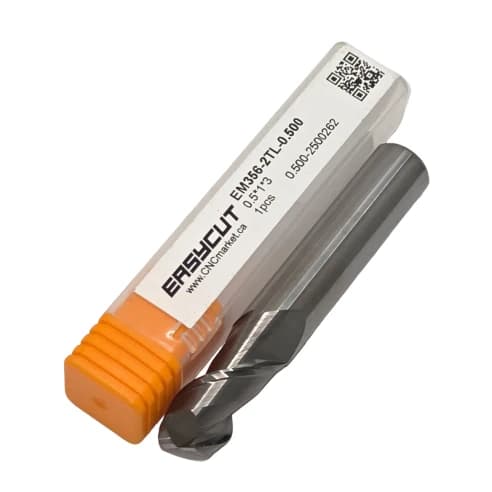
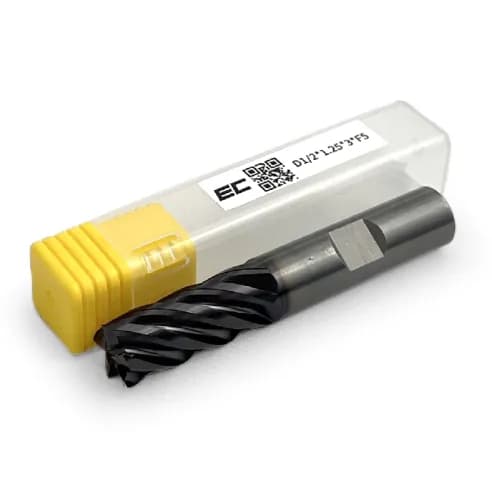
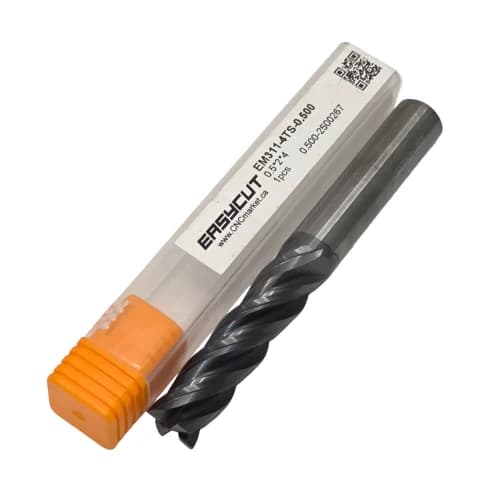
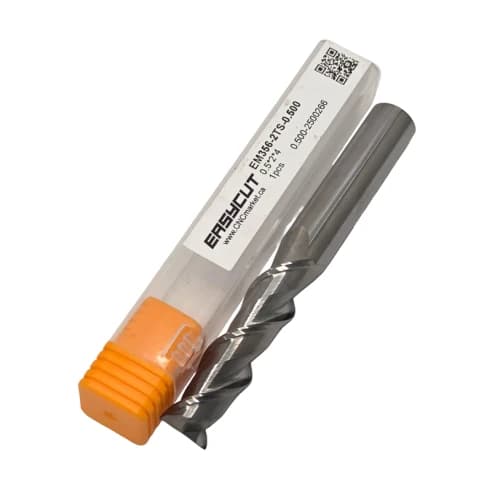
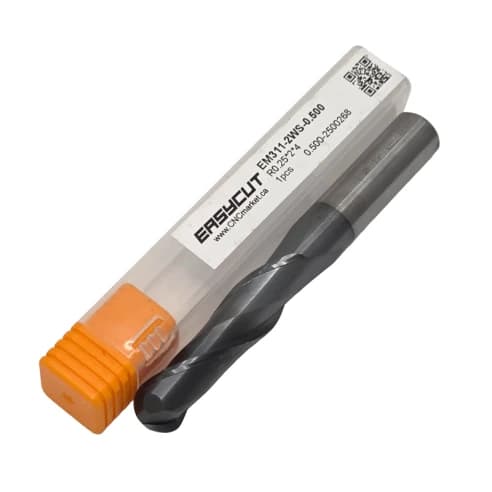
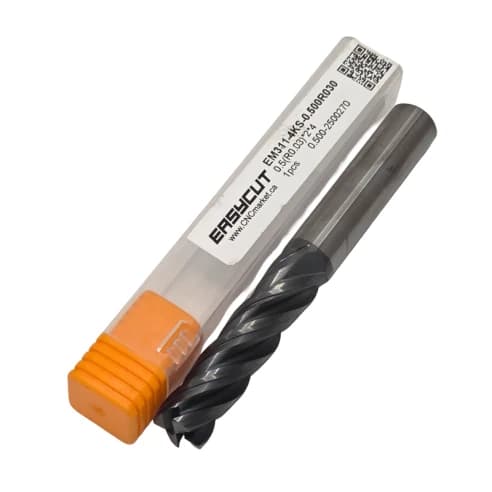
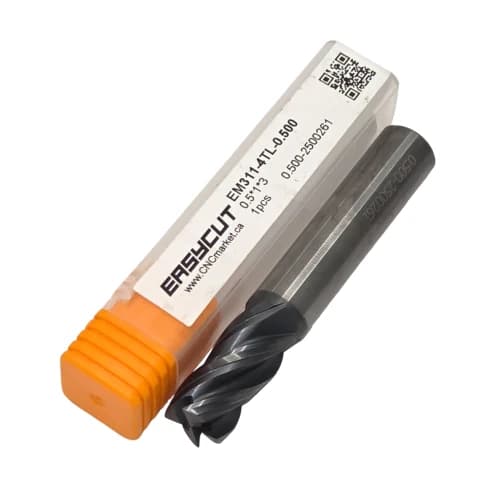
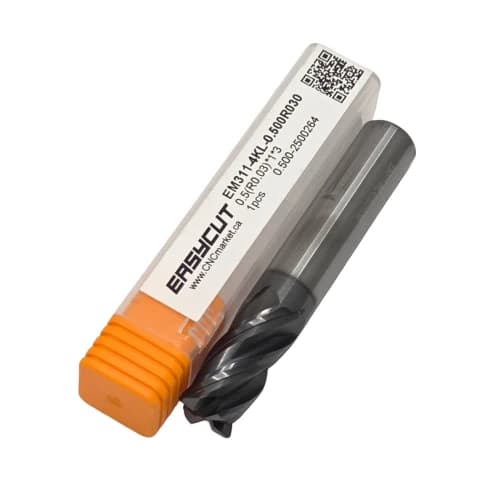
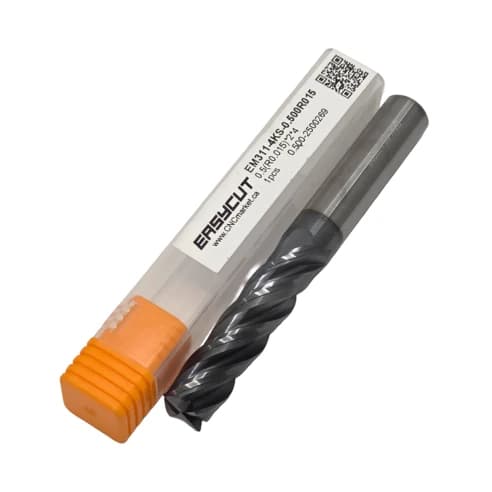
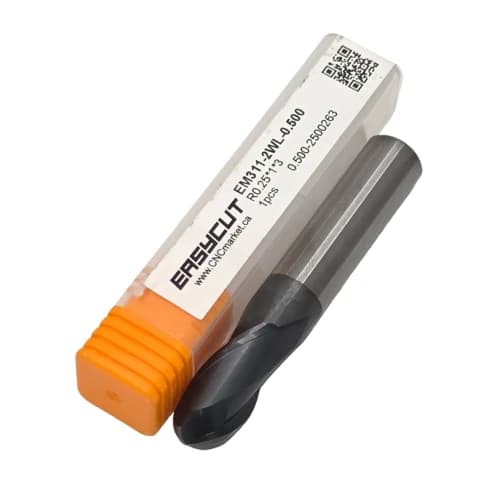
<h2>1/2" Carbide End Mills</h2>
<p>1/2" (0.5", 12.7 mm) is the size at which the cutter stops being the weak link. A 1/2" tool is about sixteen times stiffer in bending than a <a href="/catalog/end-mills/1-4-end-mill">1/4"</a> one, so deflection and breakage largely stop being the problem. What limits the cut from here on is the machine: how much power the spindle can actually deliver, and how well the holder keeps hold of the tool.</p>
<p>The range below covers <a href="/catalog/end-mills/square-end-mill">square</a>, <a href="/catalog/end-mills?properties_corner-type=bull-nose">corner radius</a> and <a href="/catalog/end-mills/ball-nose-end-mill">ball nose</a> profiles in <a href="/catalog/end-mills/2-flute-end-mill">2</a>, 3, <a href="/catalog/end-mills/4-flute-end-mill">4</a> and 5 flutes, coated and uncoated, in standard and long flute lengths. Details are on each product page.</p>
<h2>Spindle power, and why the number on the machine misleads</h2>
<p>Cutting steel takes roughly one horsepower for every cubic inch of metal removed per minute. Aluminum takes about a third of that. Those two numbers decide what a 1/2" cutter can do on your machine, and they are usually the reason a heavy cut stalls or chatters rather than anything about the tool.</p>
<p>The catch is the power curve. A 1/2" end mill at 300 SFM in steel runs about 2,300 rpm, and most machining centres do not make rated power down there - a belt-driven spindle without a gear range often delivers a fraction of its headline horsepower at low rpm. So the honest question is not "how many horsepower does the machine have" but "how many does it have at the rpm this cut actually runs".</p>
<p>If the answer is "not many", the fix is not a different cutter. Reduce radial engagement and let axial depth and feed carry the removal rate, the same way an adaptive path works at <a href="/catalog/end-mills/3-8-end-mill">3/8"</a>. Light radial engagement cuts the instantaneous power demand sharply while keeping the metal coming off.</p>
<h2>Holding a 1/2" cutter</h2>
<p>Side and axial loads at this diameter are the largest anywhere in this range, and a tool that moves in the holder ruins the part before it ruins the cutter.</p>
<p>Use a Weldon flat where the tool has one and the holder takes it - a screw against a flat cannot pull out. A power milling chuck is the next best. A plain <a href="/catalog/accessories-for-tools/collets">ER collet</a> will hold a 1/2" tool for finishing and light work, but it is the wrong choice for a heavy roughing pass: clamping force is friction only, and friction is what gives way when the cut loads up.</p>
<p>Whatever the holder, seat the shank fully, keep the taper and the bore clean, and check runout. At 1/2" a few thousandths of runout puts noticeably uneven load across the flutes and shows up as an uneven finish long before the tool complains.</p>
<h2>When to stay at 3/8" instead</h2>
<p>Bigger is only faster if the machine can drive it. On a lighter spindle a 1/2" cutter frequently ends up running at <a href="/catalog/end-mills/3-8-end-mill">3/8"</a> parameters - same removal rate, more tool cost, more chance of stalling. If the spindle is power-limited rather than rigidity-limited, 3/8" run properly beats 1/2" run timidly.</p>
<p>The other reason to drop down is the corner. A 1/2" cutter cannot produce an internal radius tighter than 1/4" (0.25"), which rules it out of a lot of pocket geometry. Rough with the 1/2", finish the corners with something smaller.</p>
<p>For metric prints: 1/2" is 12.7 mm, so it sits between 12 mm and 13 mm and matches neither.</p>
<h2>Profiles and flute count</h2>
<ul>
<li><strong><a href="/catalog/end-mills?properties_corner-type=bull-nose">Corner radius</a></strong> - the default for roughing at this diameter. Heavy cuts concentrate load on the corner, and the radius is what stops it chipping.</li>
<li><strong><a href="/catalog/end-mills/square-end-mill">Square</a></strong> - where the floor and wall must meet sharp, usually on a finishing pass rather than a roughing one.</li>
<li><strong><a href="/catalog/end-mills/ball-nose-end-mill">Ball nose</a></strong> - 3D roughing and finishing on curved surfaces.</li>
</ul>
<p><a href="/catalog/end-mills/2-flute-end-mill">2</a> and 3 flutes for aluminum, where chip volume per revolution is large and the flutes need room to clear it. <a href="/catalog/end-mills/4-flute-end-mill">4</a> and 5 flutes for steel and stainless - more edges in the cut allow more feed at the same chip load, provided the spindle has the power to drive them.</p>
<h2>Buying 1/2" End Mills from CNCmarket</h2>
<p>Prices and stock are on every product page and you can order online without waiting for a quote. Delivery is free across Alberta and we ship anywhere in Canada.</p>
<p>We run our own machine shop in Calgary and cut with these tools ourselves. Tell us the machine, its spindle rating and what you are cutting, and we will tell you whether 1/2" is worth it on that setup or whether the money is better spent on a 3/8" tool run properly.</p>
<h2>Frequently Asked Questions</h2>
<accordion status="open" name="How much spindle power does a 1/2" end mill need?">
<p>Roughly one horsepower per cubic inch of steel removed per minute, and about a third of that in aluminum. Then check the machine's power curve: a 1/2" cutter in steel runs near 2,300 rpm, and many spindles deliver well under their rated horsepower at that speed.</p>
</accordion>
<accordion name="My machine stalls or chatters with a 1/2" cutter. What do I change?">
<p>Reduce radial engagement first. Cutting a narrow slice deep, rather than a wide slice shallow, drops instantaneous power demand a long way while keeping the removal rate up. Changing the tool rarely fixes a power problem.</p>
</accordion>
<accordion name="Weldon or collet for a 1/2" end mill?">
<p>Weldon where the tool has a flat and the holder takes it - a screw against a flat cannot pull out. A power milling chuck next. An ER collet is fine for finishing and light cuts, but it holds by friction alone, which is what lets go under a heavy roughing load.</p>
</accordion>
<accordion name="Is a 1/2" end mill always faster than a 3/8"?">
<p>Only if the spindle can drive it. On a power-limited machine a 1/2" tool often ends up running at 3/8" parameters, which costs more per cutter for the same removal rate. If the machine is the limit rather than the tool, 3/8" run hard beats 1/2" run cautiously.</p>
</accordion>
<accordion name="What internal corner radius does a 1/2" end mill leave?">
<p>1/4", or 0.25" - half the cutter diameter. Rough with the 1/2" and finish tighter corners with a smaller tool.</p>
</accordion>
<accordion name="What spindle speed does a 1/2" carbide end mill need?">
<p>About 2,300 rpm for 300 SFM in steel and about 6,100 for 800 SFM in aluminum. Both are easy speeds to reach - the difficulty at this diameter is having torque and power available there, not rpm.</p>
</accordion>
<accordion name="Do you have 1/2" end mills in stock in Canada?">
<p>Yes. We hold stock in Calgary and the quantity shows on each product page. Order online without a quote, free delivery across Alberta, shipping anywhere in Canada.</p>
</accordion>