
Square End Mill
Total found: 184


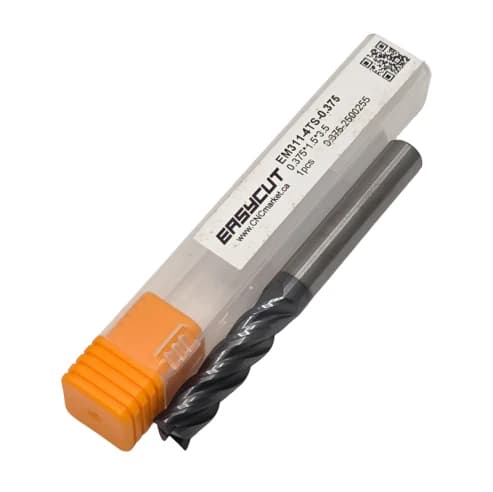


<h2>Square End Mills</h2>
<p>A square end mill cuts a flat floor and a 90 degree wall, and that is the only reason to choose one. Everything else about it - rigidity, tool life, how hard you can push it - is worse than the <a href="/catalog/end-mills?properties_corner-type=bull-nose">corner radius</a> version of the same tool. You take the square profile when the drawing requires it, not because it is the general-purpose shape.</p>
<p>The range below covers square-profile cutters in <a href="/catalog/end-mills/2-flute-end-mill">2</a>, 3 and <a href="/catalog/end-mills/4-flute-end-mill">4 flutes</a> across the diameters we stock, coated and uncoated. Details are on each product page.</p>
<h2>The corner is the product, and the weak point</h2>
<p>Cutting load concentrates where the end face meets the periphery. On a corner radius tool that load is spread along an arc. On a square tool it lands on an edge with nothing behind it.</p>
<p>So square end mills fail at the corner, and they fail there first. That matters more than it sounds, because the corner is the exact feature you bought the tool for: once it wears or chips, the tool is still cutting, but the sharp 90 degrees it was supposed to leave has quietly become a rounded, undersized one. The part changes before the tool obviously fails.</p>
<p>If you are checking a square end mill for wear, check the corner, not the flanks.</p>
<h2>What "sharp corner" actually means</h2>
<p>No ground carbide tool has a mathematically sharp corner. Every cutting edge carries a small edge preparation - a hone or a light break - because a perfectly sharp edge would chip on the first pass. A square end mill therefore leaves a corner that is very slightly rounded, not a true zero-radius intersection.</p>
<p>This is worth knowing before a drawing gets quoted. If a print specifies a genuinely sharp internal corner, milling cannot produce it with any cutter, at any price. The options are a corner relief in the design, a wire EDM, broaching, or - the usual answer - agreeing a small radius with whoever drew it. A supplier who tells you a square end mill will give you a perfect sharp internal corner is selling, not advising.</p>
<h2>Rough with a radius, finish with square</h2>
<p>The practical way to use square end mills is sparingly.</p>
<p>Take the bulk of the material out with a <a href="/catalog/end-mills?properties_corner-type=bull-nose">corner radius</a> cutter, which will survive the heavy cut and the deep engagement. Then bring in the square tool for a light finishing pass that establishes the floor, the wall and the corner. The square cutter sees a fraction of the load, so its corner stays sharp for many more parts, and you are not spending a fragile edge on roughing work that a stronger geometry does better.</p>
<p>On short runs this looks like an extra tool change. On anything repetitive it pays for itself in corners that still measure the same on part fifty.</p>
<h2>Floors, walls and where the profile shows</h2>
<p>A square end mill leaves a flat floor in a single pass. A <a href="/catalog/end-mills/ball-nose-end-mill">ball nose</a> leaves scallops that need step-over control and more passes to blend, so for a floor that has to be flat and on size, square is the tool.</p>
<p>On walls, deflection shows up as taper: the tool bends away from the cut at the top where it is unsupported and cuts closer to size at the bottom. A light finishing pass with small radial engagement is what removes it - the same reason the finishing pass exists at all.</p>
<p>Where the floor meets the wall, a square tool leaves a sharp internal junction and a corner radius tool leaves a fillet. If the part is loaded in service, the fillet is usually the better engineering answer as well as the better tooling one.</p>
<h2>Choosing a square end mill</h2>
<p>Diameter is set by the smallest internal corner the part needs, since the cutter cannot make a corner tighter than its own radius - <a href="/catalog/end-mills/1-8-end-mill">1/8"</a>, <a href="/catalog/end-mills/3-16-end-mill">3/16"</a>, <a href="/catalog/end-mills/1-4-end-mill">1/4"</a>, <a href="/catalog/end-mills/3-8-end-mill">3/8"</a> and <a href="/catalog/end-mills/1-2-end-mill">1/2"</a>.</p>
<p>Flute count follows the material: <a href="/catalog/end-mills/2-flute-end-mill">2</a> or 3 flutes for aluminum and non-ferrous, <a href="/catalog/end-mills/4-flute-end-mill">4</a> for steel and stainless.</p>
<p>Coating follows the heat. Coated for steel and stainless, uncoated for aluminum where the problem is adhesion rather than temperature.</p>
<h2>Buying Square End Mills from CNCmarket</h2>
<p>Prices and stock are on every product page and you can order online without waiting for a quote. Delivery is free across Alberta and we ship anywhere in Canada.</p>
<p>We run our own machine shop in Calgary and cut with these tools ourselves. If you are looking at a drawing with a tight internal corner and are not sure whether it can be milled at all, send it over - that question is cheaper to answer before the job is quoted than after.</p>
<h2>Frequently Asked Questions</h2>
<accordion status="open" name="When should I use a square end mill instead of a corner radius one?">
<p>When the drawing needs a flat floor meeting a wall at a sharp 90 degrees. For everything else a corner radius tool does the same work and lasts longer, because the radius spreads the load that a square corner takes on a single edge.</p>
</accordion>
<accordion name="Can a square end mill produce a truly sharp internal corner?">
<p>No. Every ground carbide edge carries a small hone or edge break, so the corner it leaves is slightly rounded. More importantly, a rotating cutter cannot make an internal corner tighter than its own radius at all. A genuinely sharp internal corner needs a corner relief in the design, wire EDM or broaching.</p>
</accordion>
<accordion name="Why did my square end mill stop holding size?">
<p>Look at the corner. It is the first part of the tool to wear, and as it rounds off the part gets a rounded, slightly undersized corner while the tool still appears to cut normally. Inspect the corner rather than the flanks, and change on corner condition.</p>
</accordion>
<accordion name="Should I rough with a square end mill?">
<p>Preferably not. Rough with a corner radius cutter and save the square tool for a light finishing pass. The square corner is fragile, and spending it on heavy cuts costs you the sharp corner you bought the tool for.</p>
</accordion>
<accordion name="Why is my wall tapered?">
<p>Tool deflection. The cutter bends away from the wall where it is least supported and cuts closer to size lower down. A finishing pass at light radial engagement, with the shortest tool that reaches, is what takes the taper out.</p>
</accordion>
<accordion name="Do you have square end mills in stock in Canada?">
<p>Yes. We hold stock in Calgary and the quantity shows on each product page. Order online without a quote, free delivery across Alberta, shipping anywhere in Canada.</p>
</accordion>

